Annapurna Base Camp vs. Circuit: Which is for You?
Published March 13, 2026 by Archana Pandey
Blogs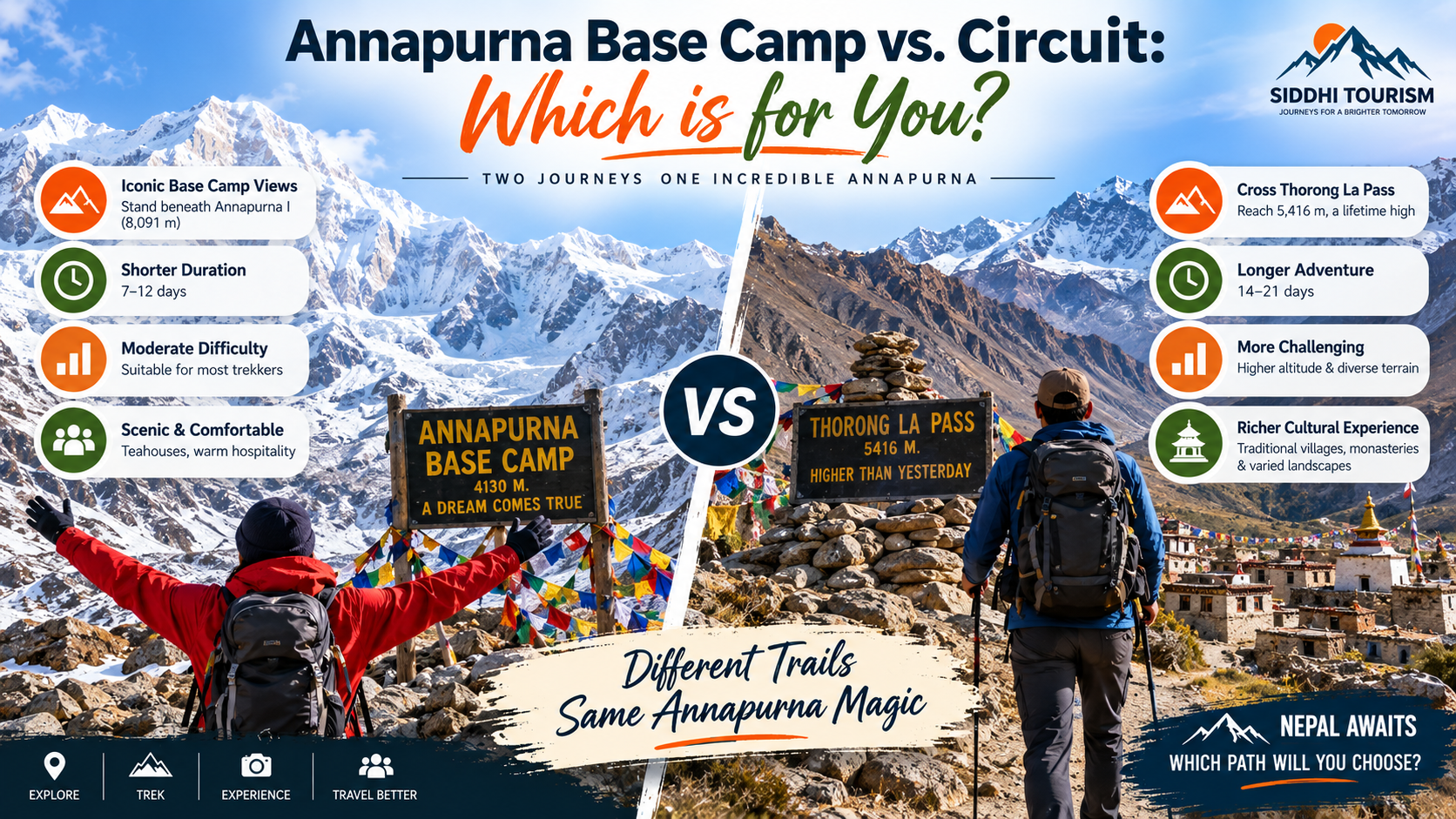
wp_posts
wp_posts lang=”en”>
Annapurna Base Camp vs. Annapurna Circuit: Choosing Your Ultimate Himalayan Adventure
The Himalayas whisper tales of unparalleled beauty, challenging trails, and profound cultural encounters. Among Nepal’s most revered trekking destinations, the Annapurna region stands out, offering two legendary journeys: the Annapurna Base Camp trek and the Annapurna Circuit trek. Both promise an unforgettable adventure, leading you deep into the heart of the majestic Annapurna massif. But how do you choose between these two iconic routes? Are you seeking a quicker, direct ascent to the stunning Annapurna Sanctuary, or an epic circumambulation that showcases an incredible diversity of landscapes and cultures?
This comprehensive guide will break down everything you need to know about the Annapurna Base Camp trek and the Annapurna Circuit, helping you weigh the pros and cons, understand the differences in duration, difficulty, scenery, and cultural immersion, so you can confidently decide which Himalayan odyssey is perfectly suited for you.
Understanding the Annapurna Region: A Himalayan Gem
Nestled in north-central Nepal, the Annapurna region is part of the Annapurna Conservation Area Project (ACAP), the first and largest conservation area in Nepal. Established in 1986, ACAP protects a vast area of diverse ecosystems, from subtropical forests to alpine deserts, and is home to a rich tapestry of ethnic groups, including Gurungs, Magars, Brahmins, Chhetris, and Tibetan Buddhists. Trekking here isn’t just about the mountains; it’s an immersive experience into a living, breathing landscape where nature and culture intertwine.
The Annapurna range itself boasts some of the world’s highest peaks, including Annapurna I (8,091m), Machapuchare (6,993m), Dhaulagiri (8,167m – visible from parts of AC), and the Annapurna South (7,219m). The trails wind through charming villages, terraced fields, dense rhododendron forests, and across high mountain passes, offering panoramic views that will leave you breathless at every turn.
Annapurna Base Camp Trek: The Direct Route to the Sanctuary
What is the Annapurna Base Camp Trek?
The Annapurna Base Camp trek, often referred to as the “ABC trek,” is a journey that takes you directly into the heart of the Annapurna Sanctuary, a natural amphitheater ringed by some of the world’s highest mountains. It’s an out-and-back trek (though variations exist) that typically starts from Nayapul or Ghandruk, ascending through picturesque villages and lush forests to the dramatic glacial basin of Annapurna Base Camp.
Key Features & Highlights of the ABC Trek:
- Duration: Typically 7-12 days, depending on your starting point, pace, and acclimatization schedule.
- Difficulty: Moderate. While it involves significant ascent and descent, the daily walking hours are manageable, and there are no extreme high passes.
- Maximum Altitude: 4,130 meters (13,550 feet) at Annapurna Base Camp itself.
- Scenery: The ABC trek is renowned for its stunning, close-up mountain views within the sanctuary. You’ll traverse vibrant rhododendron forests (especially beautiful in spring), terraced rice paddies, and traditional Gurung villages. Key peaks visible include Annapurna I, Annapurna South, Machapuchare (Fishtail), Hiunchuli, and Gangapurna.
- Cultural Immersion: Primarily focuses on Gurung culture, with opportunities to experience local village life, enjoy traditional guesthouses, and visit the hot springs at Jhinu Danda.
- Accessibility: Relatively easy to access from Pokhara, making it a popular choice for those with limited time.
Pros of Choosing the Annapurna Base Camp Trek:
- Shorter Duration: Ideal for trekkers with limited vacation time, offering a profound Himalayan experience in under two weeks.
- Less Demanding: Generally considered less physically strenuous than the Circuit, making it accessible to a wider range of fitness levels.
- Incredible Reward: The dramatic amphitheater of Annapurna Base Camp, surrounded by towering peaks, is an absolutely breathtaking sight that feels well-earned.
- Consistent Scenery: Offers classic Himalayan valley views, dense forests, and clear mountain vistas.
- No High Pass Crossing: Avoids the extreme altitude and challenging conditions of a high pass like Thorong La.
Cons of Choosing the Annapurna Base Camp Trek:
- Out-and-Back Route: While variations exist, much of the trek involves traversing the same path, which some trekkers might find less diverse.
- Can Be Crowded: As a popular, shorter trek, some sections of the trail, particularly in peak season, can feel more crowded than parts of the Circuit.
- Less Cultural Diversity: While culturally rich, it primarily focuses on Gurung villages, offering less variation than the Circuit.
Annapurna Circuit Trek: The Epic Journey Around the Massif
What is the Annapurna Circuit Trek?
The Annapurna Circuit trek is an epic adventure that literally circumnavigates the entire Annapurna mountain range. It’s a journey of incredible diversity, taking you through a vast spectrum of landscapes, climates, and cultures, culminating in the challenging crossing of Thorong La Pass (5,416m), one of the highest trekking passes in the world. Traditionally starting from Besisahar, the trek ends in Nayapul or Pokhara, showcasing the full grandeur of the Himalayas.
Key Features & Highlights of the Annapurna Circuit Trek:
- Duration: Typically 12-21 days, depending on your starting/ending points (road extensions can shorten it), pace, and side trips.
- Difficulty: Strenuous. The length of the trek, combined with the high altitude and demanding crossing of Thorong La Pass, makes it significantly more challenging than the ABC trek.
- Maximum Altitude: 5,416 meters (17,769 feet) at Thorong La Pass.
- Scenery: Unparalleled diversity! You’ll trek through lush subtropical forests and paddy fields in the lowlands, ascend into arid alpine deserts reminiscent of Tibet, witness towering cliffs and the world’s deepest gorge (Kali Gandaki), and enjoy panoramic views of the entire Annapurna and Dhaulagiri ranges.
- Cultural Immersion: An extraordinary cultural journey. The eastern side features Hindu villages and Gurung communities, while the western side (Manang and Mustang regions) boasts strong Tibetan Buddhist influences, ancient monasteries, prayer flags, and unique mud-brick villages.
- Sense of Achievement: Crossing Thorong La Pass is a significant accomplishment and a highlight for most trekkers.
Pros of Choosing the Annapurna Circuit Trek:
- Unparalleled Scenic Diversity: From lush valleys to alpine deserts, the scenery changes dramatically almost daily, keeping the journey fresh and exciting.
- Rich Cultural Tapestry: Experience a fascinating blend of Hindu and Tibetan Buddhist cultures, interacting with diverse ethnic groups along the way.
- Epic Sense of Achievement: Successfully crossing the Thorong La Pass is a momentous accomplishment, offering immense personal satisfaction.
- “True” Expedition Feel: Offers a more profound sense of journey and exploration, as you truly circumnavigate a major mountain range.
- More Varied Trail: As a circular route, you rarely retrace your steps, providing constant new perspectives.
Cons of Choosing the Annapurna Circuit Trek:
- Longer Duration: Requires a significant time commitment, often 2-3 weeks, which may not be feasible for everyone.
- More Physically Demanding: The high altitude and challenging terrain, especially the Thorong La Pass, require a higher level of fitness and mental fortitude.
- Higher Risk of Altitude Sickness: The extreme altitude of Thorong La Pass necessitates careful acclimatization and carries a greater risk of Acute Mountain Sickness (AMS).
- Road Construction: Parts of the lower sections of the Circuit now have roads, which can detract from the wilderness experience. However, alternative trails have been developed to bypass most road sections.
Head-to-Head Comparison: ABC vs. AC
To help you visualize the differences, here’s a direct comparison between the Annapurna Base Camp trek and the Annapurna Circuit:
| Feature | Annapurna Base Camp Trek (ABC) | Annapurna Circuit Trek (AC) |
|---|---|---|
| Duration | 7-12 days | 12-21 days (can be shortened with driving) |
| Difficulty | Moderate | Strenuous |
| Max Altitude | 4,130m (Annapurna Base Camp) | 5,416m (Thorong La Pass) |
| Scenery | Lush rhododendron forests, terraced fields, close-up valley views of Annapurna peaks. | Incredible diversity: subtropical to alpine desert, deepest gorge, panoramic range views. |
| Cultural Immersion | Primarily Gurung villages; hot springs at Jhinu Danda. | Hindu and Tibetan Buddhist cultures, diverse ethnic groups, ancient monasteries. |
| High Pass Crossing | No | Yes (Thorong La Pass, 5,416m) |
| Logistics | Easier to plan due to shorter duration. | More complex due to longer duration, higher altitude, and route planning. | Permits Required | ACAP (Annapurna Conservation Area Permit), TIMS (Trekkers’ Information Management System) card | ACAP, TIMS |
| Cost (Avg.) | Generally lower due to shorter duration (approx. $600-$1200 USD without flights, with guide/porter). | Generally higher due to longer duration (approx. $1000-$2000 USD without flights, with guide/porter). |
| Crowds | Can be quite crowded, especially in peak season on main trails. | Can be crowded in certain sections, but trails can spread out trekkers more. |
Which Trek is Right For You? A Decision Guide
Ultimately, the best trek depends on your personal preferences, time availability, and physical condition.
Choose the Annapurna Base Camp Trek if:
- You have limited time (typically 1-2 weeks for the trek itself).
- You prefer a moderate challenge and are relatively new to multi-day high-altitude trekking.
- Your primary goal is to reach a spectacular, close-up mountain sanctuary without an extreme high pass crossing.
- You want a classic Himalayan experience that focuses on lush landscapes and Gurung culture.
- You are looking for a fantastic reward for a manageable effort.
Choose the Annapurna Circuit Trek if:
- You have ample time (2-3 weeks for the full experience).
- You are seeking a significant physical challenge and are an experienced trekker with a good level of fitness.
- You desire unparalleled scenic and cultural diversity, wanting to witness a vast range of ecosystems and ethnic groups.
- You are drawn to the immense personal satisfaction of crossing a high-altitude pass like Thorong La.
- You crave a truly epic, immersive journey around an entire mountain range.
Essential Preparation for Both Treks
Regardless of which Annapurna Base Camp trek or Annapurna Circuit adventure you choose, thorough preparation is key to a safe and enjoyable journey.
- Fitness: Both treks require good physical condition. Focus on cardiovascular endurance (running, cycling, swimming), strength training (legs and core), and hiking with a weighted pack. Begin your training several months in advance.
- Gear: Invest in quality trekking boots (broken in!), layered clothing (moisture-wicking base layers, insulating mid-layers, waterproof outer shell), a good backpack, sleeping bag, trekking poles, sunglasses, hat, and sunscreen.
- Permits: You will need an Annapurna Conservation Area Permit (ACAP) and a Trekkers’ Information Management System (TIMS) card for both treks. These can be obtained in Kathmandu or Pokhara.
- Guide/Porter: While not strictly mandatory for ABC, hiring a licensed guide and/or porter is highly recommended for safety, cultural insights, and supporting the local economy. For the Annapurna Circuit, especially crossing Thorong La, a guide is strongly advisable due to weather changes and route finding.
- Altitude Sickness: Understand the symptoms of Acute Mountain Sickness (AMS) and how to prevent it (slow ascent, hydration, rest days). The higher altitude of the Annapurna Circuit makes this even more critical.
- Travel Insurance: Essential! Ensure your policy covers high-altitude trekking and emergency helicopter evacuation.
- Cash: Most remote villages do not have ATMs; carry sufficient Nepali rupees for expenses.
Frequently Asked Questions (FAQs)
- Is solo trekking allowed in the Annapurna region?
- Yes, solo trekking is generally allowed in the Annapurna region for foreigners. However, it’s highly recommended to trek with a guide or at least a trekking partner, especially for the more challenging Annapurna Circuit trek due to the high altitude of Thorong La Pass and unpredictable weather.
- What is the best time of year for Annapurna treks?
- The best times are during the post-monsoon autumn (September to November) for clear skies and moderate temperatures, and pre-monsoon spring (March to May) when rhododendrons bloom, though it can be a bit hazier.
- How much does it cost to trek the Annapurna Base Camp/Circuit?
- Costs vary widely depending on whether you hire a guide/porter, the duration, accommodation choices, and food. Generally, expect to budget around $50-$100 USD per day for independent trekking (food, accommodation, permits) and $70-$150 USD per day if hiring a guide/porter, excluding international flights and major gear purchases.
- What permits are required for the Annapurna region?
- For both the Annapurna Base Camp trek and the Annapurna Circuit, you need two permits: the Annapurna Conservation Area Permit (ACAP) and the Trekkers’ Information Management System (TIMS) card. These can be obtained at the Nepal Tourism Board offices in Kathmandu or Pokhara.
- Is it safe to trek in the Annapurna region?
- With proper preparation, acclimatization, and adherence to safety guidelines, trekking in the Annapurna region is generally safe. The main risks include altitude sickness, weather changes, and potential trail hazards. Going with a guide, having appropriate gear, and adequate insurance significantly enhances safety.
Conclusion: Your Annapurna Adventure Awaits
Both the Annapurna Base Camp trek and the Annapurna Circuit trek offer extraordinary opportunities to experience the grandeur of the Himalayas and the rich culture of Nepal. There is no single “better” trek; rather, there is the trek that is better for you.
If your time is limited, your fitness is moderate, and you dream of standing amidst a breathtaking mountain sanctuary with relatively less commitment, the Annapurna Base Camp trek will deliver an unforgettable experience. If you crave an epic, long-distance journey through incredibly diverse landscapes, a profound cultural immersion, and the immense satisfaction of conquering a high mountain pass, then the Annapurna Circuit is calling your name.
Whichever path you choose, the Annapurna region promises an adventure that will challenge you, inspire you, and leave you with memories to last a lifetime. So, assess your priorities, prepare diligently, and get ready to embark on your ultimate Himalayan odyssey!
References
- Nepal Tourism Board (Official Website)
- National Trust for Nature Conservation – Annapurna Conservation Area Project (ACAP)
- Lonely Planet – Annapurna Circuit Trek
- Lonely Planet – Annapurna Base Camp Trek
- Nepal Himalayan Treks – Annapurna Circuit Trek Information