“`html
Discovering the Timeless Architecture of Patan & Bhaktapur: Unveiling Nepal’s Ancient Kingdoms
Nestled within the verdant embrace of the Kathmandu Valley, two ancient cities stand as living museums, their brick-lined squares and intricately carved temples whispering tales of bygone eras. Patan, often called the “City of Fine Arts,” and Bhaktapur, known as the “City of Devotees,” are not merely destinations; they are journeys back in time, offering an unparalleled glimpse into the architectural brilliance of the Newari people. This exploration will guide you through the distinct yet harmonious architectural wonders that define these UNESCO World Heritage Sites, culminating in a deep dive into the majestic **Bhaktapur Durbar Square**.
The Kathmandu Valley: A Cradle of Newari Civilization
The Kathmandu Valley, a bowl-shaped marvel teeming with cultural and historical significance, has for centuries been the heartland of Newari civilization. The Newars, the indigenous inhabitants of the valley, are renowned for their unique artistic and architectural traditions, which reached their zenith during the Malla dynasty (12th-18th centuries). This era saw the construction of countless temples, palaces, and residential buildings, characterized by their exquisite wood carvings, brickwork, metal craftsmanship, and pagoda-style roofs.
A UNESCO World Heritage Treasure
Both Patan Durbar Square and **Bhaktapur Durbar Square**, along with Kathmandu Durbar Square and other sites, collectively form the Kathmandu Valley UNESCO World Heritage Site. This designation recognizes their outstanding universal value, preserving centuries of artistic and architectural evolution. The squares serve as focal points, featuring royal palaces, courtyards, and a dense concentration of temples, each a testament to the skill and devotion of their creators.
Patan Durbar Square: A City of Fine Arts and Metalwork
Patan, officially Lalitpur (City of Beauty), lives up to its name with an artistic heritage that is arguably the most refined in the Kathmandu Valley. Patan Durbar Square is an open-air spectacle of Newari architecture, showcasing an extraordinary fusion of Hindu and Buddhist influences. Unlike the sprawling expanses of some other squares, Patan’s heart feels more intimate, its temples and palaces seemingly stacked one upon another, each vying for attention with its intricate details.
Architectural Marvels of Patan
The buildings here are predominantly crafted from baked brick, timber, and often adorned with stunning bronze, copper, and gilt-metal work. The dominant architectural styles are the multi-tiered pagoda and the Hindu shikhara style.
- Krishna Mandir: Perhaps the most celebrated structure in Patan Durbar Square, this stone temple is a masterpiece of Shikhara style. Built in the 17th century by King Siddhinarsingh Malla, it is unique for being constructed entirely of stone with 21 golden pinnacles. Its intricate carvings depict scenes from the Mahabharata and Ramayana, often described as a “poem in stone.”
- Patan Museum (Old Royal Palace): Housed within the former Malla royal palace, the museum itself is an architectural treasure. Its courtyards, especially Sundari Chowk, with its exquisitely carved Golden Window and Tusha Hiti (royal bath), exemplify the peak of Newari craftsmanship. The museum offers insights into Patan’s history and its religious art.
- Hiranya Varna Mahavihar (Golden Temple): A short walk from the main square, this 12th-century Buddhist monastery is a breathtaking spectacle. Its main shrine is adorned with a golden facade, silver and bronze statues, and intricate repoussé work, showcasing Patan’s mastery in metal crafts.
- Mahaboudha Temple: Known as the ‘Temple of a Thousand Buddhas,’ this terra cotta temple is a replica of the Mahabodhi Temple in Bodhgaya, India. Each brick bears a tiny image of Buddha, creating a mesmerizing pattern.
Patan’s enduring legacy lies in its unparalleled sculptural and metallic artistry. Artisans here have for centuries passed down techniques for creating deities, ritual objects, and architectural adornments, making Patan a living testament to Newari craftsmanship.
Journey to the Heart of Medieval Nepal: Bhaktapur
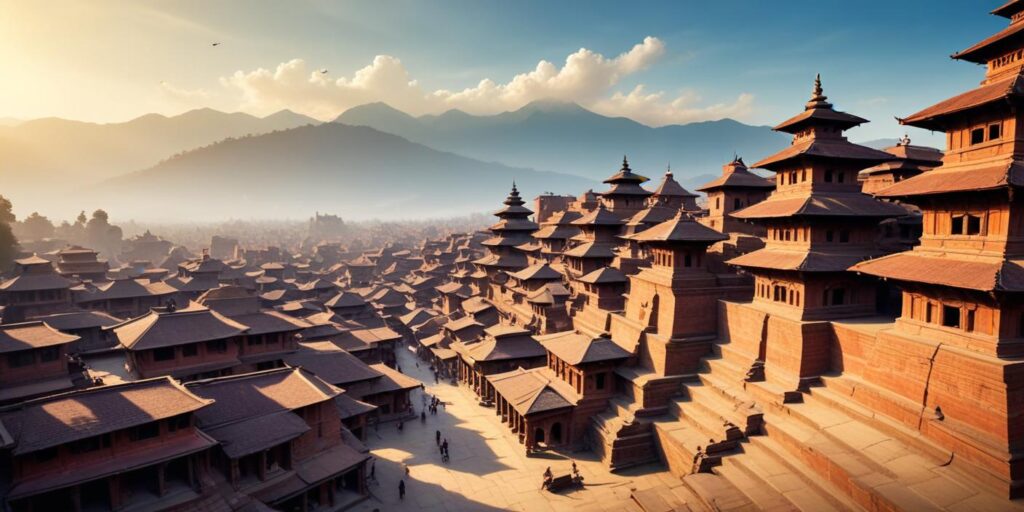
As you leave the refined artistry of Patan and venture east, you arrive at Bhaktapur, a city that offers a more authentic and immersive medieval experience. Bhaktapur, meaning “Place of Devotees,” feels like stepping into an entirely different era. It is the largest and best-preserved of the three Malla kingdoms of the Kathmandu Valley, often described as a city frozen in time. Its car-free cobbled streets, traditional pottery workshops, and vibrant local life paint a vivid picture of Newari culture.
Unveiling the Grandeur of Bhaktapur Durbar Square
The crown jewel of this ancient city is undoubtedly the magnificent **Bhaktapur Durbar Square**. This sprawling royal plaza, much larger and more open than Patan’s, served as the seat of the Malla kings and is an astonishing showcase of their power, piety, and artistic vision. It is less about metalwork and more about the grandeur of brick, wood, and colossal structures, reflecting a different facet of Newari architectural prowess.
- The 55 Window Palace: This splendid palace, built by King Yaksha Malla in the 15th century and renovated by King Bhupatindra Malla in the 17th century, is the central attraction of **Bhaktapur Durbar Square**. Its most distinctive feature is the façade adorned with 55 intricately carved wooden windows, each a unique piece of art, showcasing the pinnacle of Newari wood carving.
- The Golden Gate (Lu Dhowka): Adorning the entrance to the 55 Window Palace, the Golden Gate is arguably the most magnificent and beautifully crafted gate in the entire world. Built in 1754, this repoussé masterpiece depicts mythical creatures, Hindu deities like Garuda, and elaborate floral patterns, all rendered in gleaming gilt copper. It is a true marvel and a highlight of **Bhaktapur Durbar Square**.
- Nyatapola Temple: Towering majestically over Taumadhi Square, just a short walk from the main Durbar Square, the Nyatapola Temple is the tallest pagoda-style temple in Nepal, standing at five stories. Built in 1702 by King Bhupatindra Malla, it is dedicated to Siddhi Lakshmi, the tantric goddess of prosperity. Its robust construction and five tiers, each guarded by a pair of massive stone figures (ranging from wrestlers to elephants and lions), are a testament to Newari engineering and artistic symbolism. This temple is an iconic symbol of Bhaktapur.
- Bhairavnath Temple: Adjacent to Nyatapola, this three-tiered pagoda temple is dedicated to Bhairav, the fearsome manifestation of Shiva. While less imposing than Nyatapola, its vibrant red bricks and intricate carvings are equally captivating, making it an integral part of Bhaktapur’s architectural narrative.
- Pashupatinath Temple (Bhaktapur): Often mistaken for its larger namesake in Kathmandu, this temple in **Bhaktapur Durbar Square** is a replica in style and dedicated to Lord Shiva. Its erotic carvings on the roof struts are particularly noteworthy, reflecting aspects of Hindu tantric art.
- Lion Gate: Guarding the entrance to the royal palace complex, two imposing stone lions stand sentinel, accompanied by stone figures of Hanuman and two goddesses.
Beyond the formal structures, Bhaktapur’s architecture extends to its traditional brick and timber houses, elaborate public spouts (dhungedhara), and even the layout of its squares. The famous Pottery Square, for instance, showcases the traditional craft in action, where artisans create earthenware using centuries-old methods, making the entire city a living workshop.
Comparative Architectural Styles: Patan vs. Bhaktapur
While both Patan and Bhaktapur share the foundational elements of Newari architecture – baked brick, carved timber, multi-tiered pagoda roofs, and intricate courtyards – their expressions of these elements offer fascinating contrasts.
- Material Emphasis: Patan excels in metalwork and stone carving, exemplified by the Krishna Mandir and the Golden Temple. Its architecture often feels more delicate and adorned. **Bhaktapur Durbar Square**, in contrast, highlights the grandeur of wood carving and brick artistry, with structures like the 55 Window Palace and the towering Nyatapola temple serving as prime examples of robust, large-scale construction.
- Scale and Layout: Patan’s square is more compact and feels densely packed, creating an intimate, museum-like atmosphere where art is displayed at every turn. Bhaktapur’s main square is more expansive, with structures often grander in scale and more overtly proclaiming royal power.
- Artistic Focus: Patan has a strong Buddhist influence alongside Hindu traditions, leading to a broader array of artistic expressions. Bhaktapur, while also incorporating Buddhist elements, leans heavily into Hindu iconography and traditional Newari life, with its crafts and daily rituals more visibly integrated into the urban fabric.
- Atmosphere: Patan feels more like an artistic hub, quiet and contemplative. Bhaktapur offers a vibrant, bustling glimpse into medieval life, where the past and present seamlessly intertwine amidst its impressive structures, particularly around **Bhaktapur Durbar Square** and its surrounding squares like Taumadhi and Dattatreya.
Both cities, however, share a deep reverence for their heritage, manifested in the painstaking details that adorn every beam, pillar, and doorway. They are both windows into the rich tapestry of Nepalese history and architectural genius.
Preservation and Resilience: After the Earthquakes
The devastating Gorkha earthquake of 2015 inflicted significant damage across the Kathmandu Valley, including many structures in Patan and Bhaktapur. While both cities suffered losses, the resilience of the Newari people and the international community’s support have led to extensive restoration efforts. Many temples and palaces, particularly within **Bhaktapur Durbar Square** and Patan Durbar Square, have been meticulously reconstructed using traditional methods and materials, a testament to the enduring commitment to preserving these invaluable heritage sites for future generations. Visiting these sites today means witnessing history not only in its ancient form but also in its remarkable recovery.
Tips for Exploring Patan and Bhaktapur
- Hire a Local Guide: A knowledgeable local guide can bring the history and architectural details to life, explaining the intricate symbolism and stories behind each structure.
- Allow Ample Time: Don’t rush. Dedicate at least a full day to each city, especially to fully appreciate the entirety of Patan Durbar Square and **Bhaktapur Durbar Square** and their surrounding alleys.
- Wear Comfortable Shoes: You’ll be doing a lot of walking on cobbled streets.
- Respect Local Customs: Dress modestly, especially when visiting temples, and be mindful of local traditions.
- Explore Beyond the Main Square: While the Durbar Squares are central, venture into the narrow lanes to discover hidden courtyards, smaller temples, and artisan workshops. In Bhaktapur, don’t miss Pottery Square.
- Visit During Festivals: If your timing allows, experiencing a Newari festival like Indra Jatra or Bisket Jatra (especially vibrant in Bhaktapur) offers a unique insight into the living culture intertwined with the architecture.
Frequently Asked Questions about Patan & Bhaktapur Architecture
- Q1: What makes Newari architecture unique?
- Newari architecture is unique for its extensive use of baked red brick, intricately carved dark timber (especially for windows, doorways, and roof struts), multi-tiered pagoda roofs, and the integration of Hindu and Buddhist symbolism. It often features elaborate metalwork and stone sculptures, culminating in structures like those found in Patan and **Bhaktapur Durbar Square**.
- Q2: What is the main difference between Patan and Bhaktapur Durbar Squares?
- Patan Durbar Square is often described as more focused on artistic refinement, particularly intricate metalwork and stone carving, giving it a delicate, museum-like feel. **Bhaktapur Durbar Square** is known for its grander scale, impressive wood carvings (like the 55 Window Palace), and a more pervasive sense of medieval life, embodying robustness and monumental beauty.
- Q3: Are entry fees required to visit Patan and Bhaktapur Durbar Squares?
- Yes, both Patan Durbar Square and **Bhaktapur Durbar Square** are ticketed entry zones for foreign visitors. The fees contribute to the conservation and maintenance of these UNESCO World Heritage sites.
- Q4: Which temple is the tallest in Bhaktapur?
- The Nyatapola Temple, located in Taumadhi Square near **Bhaktapur Durbar Square**, is the tallest pagoda-style temple in Nepal, rising five stories high and dedicated to the goddess Siddhi Lakshmi.
- Q5: What impact did the 2015 earthquake have on these architectural sites?
- The 2015 Gorkha earthquake caused significant damage to many historical structures in both Patan and Bhaktapur. However, extensive national and international efforts have been underway since then to restore and rebuild these sites using traditional methods, ensuring their preservation.
Conclusion: A Timeless Architectural Odyssey
The architectural landscapes of Patan and Bhaktapur are more than just collections of old buildings; they are living testaments to human ingenuity, artistic devotion, and cultural resilience. From the delicate stone poetry of Patan’s Krishna Mandir to the towering grandeur of Bhaktapur’s Nyatapola Temple and the intricate artistry of the Golden Gate within **Bhaktapur Durbar Square**, each structure tells a story. They invite us to slow down, to observe the mastery of ancient artisans, and to connect with a history that continues to breathe life into the present.
Visiting these extraordinary cities is not just sightseeing; it’s an immersive experience that reveals the soul of Nepal, leaving an indelible mark of beauty, history, and profound architectural inspiration.
References
- UNESCO World Heritage Centre: Kathmandu Valley
- Lonely Planet: Bhaktapur
- Lonely Planet: Patan (Lalitpur)
- Hutt, Michael. “The Art and Architecture of Nepal.” Asianart.com. (An example of an academic or historical resource)
- Britannica: Bhaktapur
- Britannica: Patan
“`